

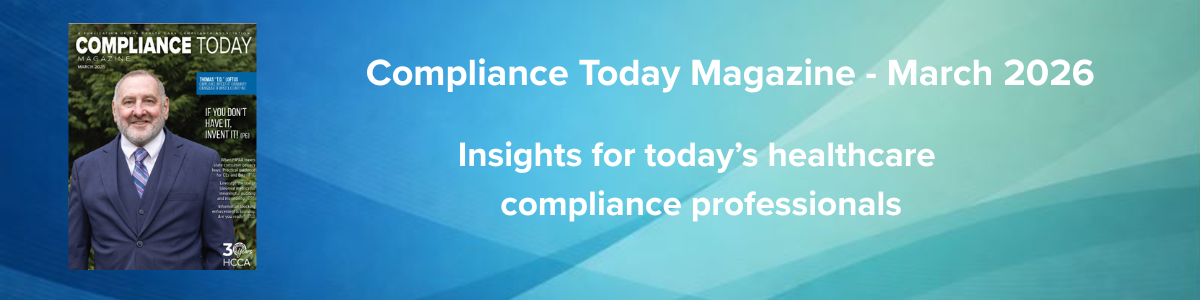
Inside this issue
Scroll down to browse the excerpts below or simply click the article link in the table of contents to read the full article--no login is required!
We value your feedback! Don't forget to complete this short 1-2 minute survey.
Cover story
Meet Thomas “T.D.” Loftus: “If you don’t have it, invent it!” An interview with Scott Moe
SM: Your path into compliance is not the typical one we see in healthcare. How did your clinical background shape the way you eventually found your way into compliance work?
TL: It became clear early on that my clinical background could be best channeled and that more people could be helped by focusing on staff development. It’s easy to overfocus on product elements, whereas the process can enlist greater, more meaningful staff participation and execution, especially outside formal meeting times.
Featured articles:
When HIPAA meets state consumer privacy laws: Practical guidance for CEs and BAs by Adam H. Greene
Since California enacted the California Consumer Privacy Act (CCPA) in 2018,1 an additional 18 states have enacted comprehensive consumer privacy laws. Additionally, Washington has enacted the My Health My Data Act governing consumer health data, and Nevada has enacted a similar law.
[CEU] Leverage the use of binomial metrics for meaningful auditing and monitoring by Frank Ruelas Sr
For many healthcare compliance professionals, the twin pillars of auditing and monitoring often represent both a critical safeguard and a persistent challenge. Historically, designing and executing truly effective audit and monitoring programs has been a complex endeavor, frequently cited as an area where organizations struggle to achieve consistent, demonstrable results. The sheer volume and intricacy of healthcare regulations, coupled with the need to ensure operational adherence across diverse departments, can make the task seem daunting.
[CEU] Information blocking enforcement is looming: Are you ready? by Emily Benoit
In September 2025, U.S. Department of Health and Human Services (HHS) Secretary Robert F. Kennedy Jr. issued a news release announcing increased federal resources dedicated to reducing information blocking.1 Shortly thereafter, HHS Office of Inspector General (OIG) and Assistant Secretary for Technology Policy/Office of the National Coordinator for Health Information Technology published a joint enforcement alert addressing compliance with the Information Blocking Rule.
Columns
Learning from CIA and IRO audits: Health IT, medical necessity, and the new compliance risk landscape by Catherine Boerner
Recent enforcement actions continue to highlight how compliance failures are rarely isolated events. The settlement involving Dr. Ameet Vohra and affiliated entities offers important lessons for compliance professionals, particularly regarding the intersection of health IT, clinical decision-making, and medical necessity oversight.
CMS updates annual non-monetary compensation limits by Betsy Wade
The Centers for Medicare & Medicaid Services (CMS) has increased the annual cap on non-monetary compensation limits under the Physician Self-Referral Law (Stark Law) for the calendar year (CY) beginning January 1, 2026.
Compliance meets creativity: Partnering with marketing for smarter strategies by J. Veronica Xu
How do you promote a product or service? The first thing that comes to your mind is probably “marketing.” Compliance is no different. It’s not only a concept, but also a habit and a culture. To make it successful, you need a strategy that can make your compliance program long-lasting, effective, and impactful. How do we achieve that? Cross-functional partnership and interdepartmental collaboration are key.
Compliance is “six seven” by Kelly M. Willenberg
Healthcare compliance has long been associated with being tedious, bureaucratic, and burdensome. For decades, it was framed as a necessary evil: a checklist of rules that impeded innovation and frustrated researchers. But in 2026, the narrative is shifting. Compliance is “six seven”! What did I say?
Beyond the final rule: Why compliance professionals should engage with NPRMs by Frank Ruelas Sr.
In the fast-paced world of regulatory compliance, it’s easy to focus solely on the final rule. Once a regulation is published, compliance teams work diligently to understand its implications, update policies, and implement necessary changes.
Change management as the missing link in prior authorization reform by Ahmed Salim
As of January, the Centers for Medicare & Medicaid Services’ (CMS) Interoperability and Prior Authorization Final Rule fundamentally reshapes how health plans and providers manage prior authorization. Much of the early conversation focused on technology:
Articles
Transcription vs. translation: A framework for compliance program development by Jared B. Gaynor
Through years of participating in training and ongoing compliance education, I have observed that newly appointed compliance officers most frequently ask how to effectively implement the various laws, regulations, and guidelines that govern modern corporate compliance programs.
[CEU] What makes a successful compliance professional by Donna Schneider
I have had the opportunity to interview several candidates this past year for various compliance and privacy positions. It has struck me that those I have hired and who have been successful in their roles when joining the organization have always asked the same question: “What makes a successful compliance professional?” To me, that question is both insightful and important. In my experience, there are several key skills that enhance individuals’ effectiveness in our profession.
The importance of compliance training for providers by Lee Ann Atkinson
Compliance training is an essential component of the onboarding process for both staff and providers. Training is vital not only for incoming employees but also on an ongoing annual basis. For physicians and advanced practice providers, compliance training involves learning about the regulations, standards, and ethical guidelines governing their medical care, documentation, billing, conflicts of interest, patient and privacy, as well as organizational policies that impact their work. Beyond meeting regulatory requirements, compliance training supports providers to function more efficiently and effectively within their practice or health system.
Modernizing federal regulation: Harnessing AI to improve clarity and reduce burden by Thomas J. Kessler
Since the mid-1970s, the amount of government regulation has grown significantly. While regulations proposed years ago may have had only a few paragraphs explaining the rationale or reasons for the regulations, nowadays the same regulation could include pages of rationale for one section and perhaps even one provision. The Centers for Medicare & Medicaid Services (CMS) is not immune to these changes.